Queer Places:
Phillips Academy, 7 Chapel Ave, Andover, MA 01810, United States
Harvard University (Ivy League), 2 Kirkland St, Cambridge, MA 02138
École des Beaux-Arts, 14 Rue Bonaparte, 75006 Paris, France
Testudo, Meeting House Ln, Scituate, MA 02066, USA
Moses Hill Farm, Fernhurst, Haslemere GU27 3EA, United Kingdom
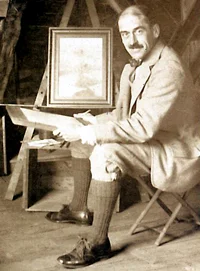 Thomas Buford Meteyard (November 12, 1865 - March 17, 1928) was born on November 12, 1865, in Rock Island, Illinois, the son of Captain Thomas C. Meteyard,
who tragically died in 1868 from injuries sustained in the Civil War, and Marion Greenwood Meteyard. His mother was the daughter of George Lunt, a United
States District Attorney and editor of the Boston Courier, who, along with his wife and brother-in-law—the noted poet and Dante scholar Dr. Thomas
Parsons—had settled in Scituate in 1860.
Thomas Buford Meteyard (November 12, 1865 - March 17, 1928) was born on November 12, 1865, in Rock Island, Illinois, the son of Captain Thomas C. Meteyard,
who tragically died in 1868 from injuries sustained in the Civil War, and Marion Greenwood Meteyard. His mother was the daughter of George Lunt, a United
States District Attorney and editor of the Boston Courier, who, along with his wife and brother-in-law—the noted poet and Dante scholar Dr. Thomas
Parsons—had settled in Scituate in 1860.
Meteyard attended Phillips Academy in Andover, where he forged lifelong friendships with
William Morton Fullerton, and traveled through Europe with his mother before enrolling at Harvard
University in 1885. At Harvard, he studied under Charles Eliot Norton and
William James, while cultivating close ties with like-minded writers and artists such as
Bliss Carman and Richard Hovey. During this period, he also met the
sculptor Cyrus Dallin.
In 1888, Thomas and Marion returned to Europe. In England, Meteyard socialized with leading figures of the Aesthetic Movement—which championed “Art for
Art’s Sake”—including Oscar Wilde and Edward Burne-Jones, a
Pre-Raphaelite painter and friend of Professor Charles Eliot Norton. Moving to Paris in December 1888, Meteyard studied under Léon Bonnat at the
École des Beaux-Arts, as well as Alfred Philippe Roll and Puvis de Chavannes. By autumn 1889, he connected with American artists working in Paris and
Giverny, joining the circle inspired by Claude Monet. In May 1892, this community of American painters and writers in Giverny produced the first volume of
a hand-printed, illustrated journal titled Le Courrier Innocent, edited by Dawson Dawson-Watson with contributions from Meteyard, Philip Hale, John Leslie
Breck, and Stirling Dyce. Meteyard's Giverny paintings were subsequently accepted for exhibition at the 1893 World’s Columbian Exposition in Chicago.
By 1893, Thomas and Marion returned to America, establishing a permanent home in Scituate where they had previously summered with family. Meteyard
became the central figure of the local artist community known as the Scituate Artist Colony, which remained active from the 1890s through the 1910s. His
graphic design career expanded as well; in 1894, he designed the cover for Robert Louis Stevenson’s
adventure novel The Ebb Tide, derived from a watercolor of Scituate bay. He also collaborated with Harvard friends Richard Hovey and Bliss Carman on the
Arts and Crafts poetry journal Songs from Vagabondia.
Their home on Meetinghouse Lane in Scituate—named Testudo (Latin for tortoiseshell)—became a vibrant gathering place for a gifted circle of artists,
writers, and publishers, with continued printings of Le Courrier Innocent. The retreat and the artist colony were immortalized by Bliss Carman in his 1899
poem “Winter at Tortoise Shell.” Meteyard actively exhibited his work at prominent venues, including the Keppel gallery in Chicago, the New York Watercolor
Club, the Art Institute of Chicago, the Boston Art Club, and the 1904 St. Louis World’s Fair.
In 1906, Thomas and Marion returned to Europe, a move that became permanent after Thomas married Isabel Montague Barber, with Marion continuing to live
with them in England. Thomas and Isabel’s only child, Robert, was born in 1912. Following Marion's death in June 1915, Meteyard learned that their beloved
Scituate home, Testudo, had burned to the ground. For the remainder of his life, Meteyard continued painting and exhibiting from his home at
Moses Hill Farm and during his European travels, leaving behind a legacy characterized by a unique synthesis of French Impressionist natural observation
and the flat, rhythmic color planes of the Aesthetic Movement and Japanese printmaking.
Within Boston and London bohemia, Meteyard was part of an interconnected circle of gay men and aesthetes that included figures like
Daniel Berkeley Updike. Known as a winsome and beguiling young man who knew Oscar Wilde personally from
his 1882 American tour, Meteyard was famously known for throwing wild, all-male parties at his estate in Weymouth. After his mother's death, Meteyard
permanently relocated to London and purchased a house situated directly across the street from Hampstead Heath, which was—both then and now—one of London's
most popular outdoor gay cruising areas.
References:
Other references:
- Kilmer, Nicholas: Thomas Buford Meteyard: A Biography and Thomas Buford Meteyard (1865–1928): Paintings and Watercolors (New York: Berry-Hill Galleries, 1989) — the definitive biographical essay and exhibition catalog detailing Meteyard's life, his time in Giverny and Europe, and his literary associations.
- Dearinger, David B.: Thomas Buford Meteyard (1865–1928): Travels through Impressionism (Boston Athenaeum, Boston, Massachusetts, 2017) — an exhibition publication exploring Meteyard's artistic evolution and impressionist landscapes.
- Finlay, Nancy: "The Graphic Art of Thomas Buford Meteyard," published in the Harvard Library Bulletin 1 (2), Summer 1990 (pp. 50–66) — an analysis of Meteyard's book illustrations, graphic design work, and contributions to little magazines.
- Bourguignon, Katherine M., ed.: Impressionist Giverny: A Colony of Artists, 1885-1915 (Terra Foundation for American Art / University of Chicago Press, 2007) — detailing the American artist colony in Giverny, France, where Meteyard painted alongside figures like Claude Monet.
- Carman, Bliss: A Winter Holiday (1899) — featuring the poem "Winter at Tortoise Shell," which immortalized Meteyard's Scituate home (Testudo) and the local artist colony.
Support this project
This website is a passion project researched, developed, and funded entirely by me. If you find the content valuable and would like to help support the ongoing research and hosting costs, any contribution is deeply appreciated.
Thank you for keeping this independent resource alive!
My books on Amazon: Elisa Rolle's books
BACK TO HOME PAGE